
To thoroughly implement the spirit of the Central Talent Work Conference, promote the integration of industry and education as well as science and education, and enhance the quality of joint training of outstanding engineers between universities and enterprises, on the morning of October 21, 2025, a delegation from China Railway Signal & Communication (Group) Corporation (hereinafter referred to as "China Railway Signal") visited the National Graduate College For Elite Engineers at Central South University. The delegation included Lai Zhou, Director of the Human Resources Department; Guoying Sun, Dean of the Electronic Equipment Technology Research Institute at the Research and Design Institute; Tianxu Guo, Deputy Director of the Artificial Intelligence Research Institute; and Chao Li, Senior Supervisor of the Human Resources Department. They engaged in discussions and exchanges on topics such as joint master's and doctoral training programs and cutting-edge research projects.
Representatives from Central South University participating in the exchange included Wujiao Dai, Vice Dean of the Graduate School; Ailiang Chen and Keke Huang, Vice Deans of the National Graduate College For Elite Engineers; Wei Li, Director of the Department of Traffic Information and Control Engineering at the School of Traffic and Transportation Engineering; Associate Professors Shile Zhang and Xuekai Cen; Teacher Xuan Zhao; Professor Hao Zhang from the School of Electronics and Information; Associate Professor Chunhua Peng; Teacher Hui Peng; Huanhuan Li from the Graduate School Training Management Office; and master's students Zhensen Wang and Shuangle Zheng from the 2026 cohort of the Electronic Information program at the School of Electronics and Information. The meeting was chaired by Vice Dean Ailiang Chen.
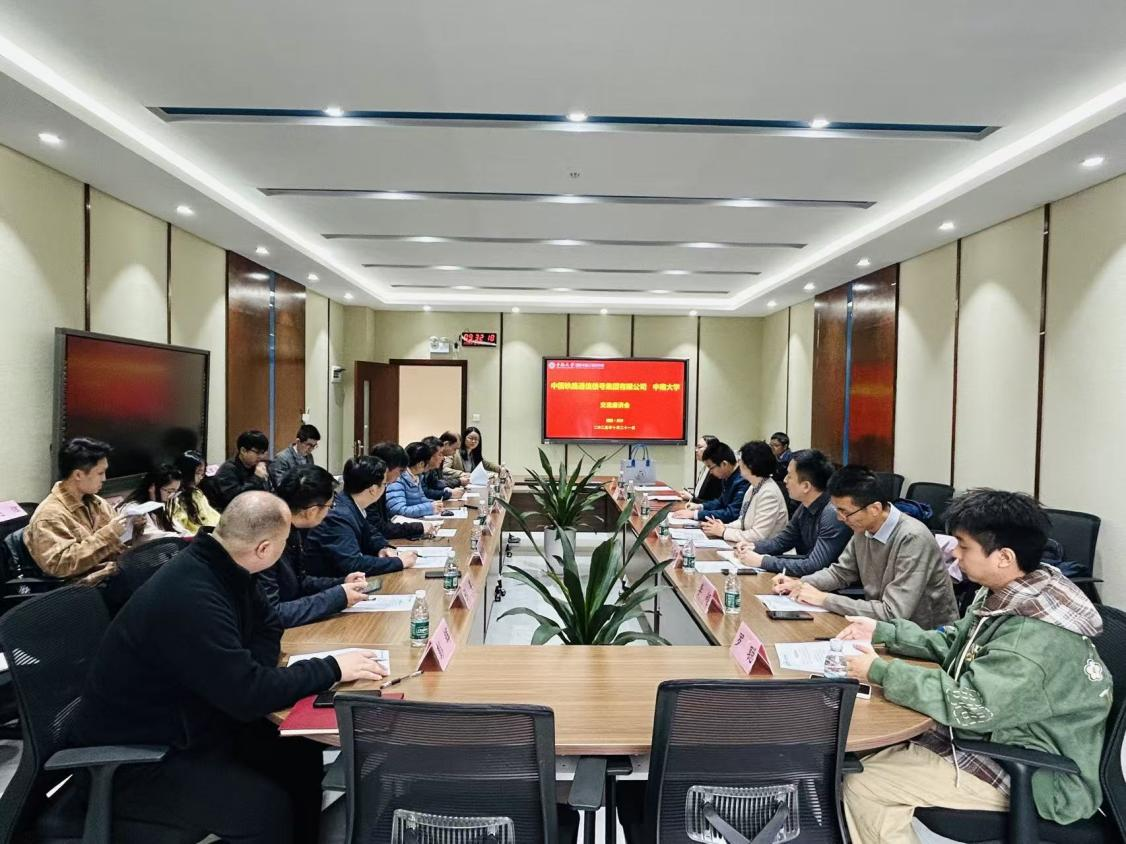
Mapping Out the Blueprint for Talent Cultivation: Introductions on Development and Planning by Both Parties
At the beginning of the meeting, Vice Dean Wujiao Dai spoke highly of the achievements made in the preliminary joint master's and doctoral training programs between China Railway Signal and Central South University. The first batch of outstanding graduates has been successfully cultivated, enabling the enterprise to attract talent with precision while also exploring an effective collaborative education pathway. He pointed out that in the future, both parties should focus on enrollment, project matching, student management during enterprise placements, and student retention to further enhance the effectiveness of joint master's and doctoral training.
During the meeting, Vice Dean Ailiang Chen explained the school's "Three Chains, Three Integrations" education practice, which relies on Central South University's disciplinary chains in non-ferrous metals, rail transit, and medical healthcare to carry out cultural integration, disciplinary integration, and industry-education integration. She noted that in the practice of joint master's and doctoral training, it is essential to focus not only on cultivating engineering practice and innovation capabilities but also to pay attention to students' mental health, ensure vocational education continuity, and strengthen university-enterprise exchanges.
Director Lai Zhou introduced the basic situation of the enterprise. While consolidating its core business in rail transit, China Railway Signal is expanding into emerging businesses such as intelligent rail transit, creating urgent demand for outstanding engineers. She specifically mentioned that two outstanding graduates from the joint engineering master's and doctoral training program with Central South University have stayed to work at the enterprise, demonstrating the initial effectiveness of the joint training program. She expressed hope for deepening cooperation in the future to attract more Central South University students to join China Railway Signal.
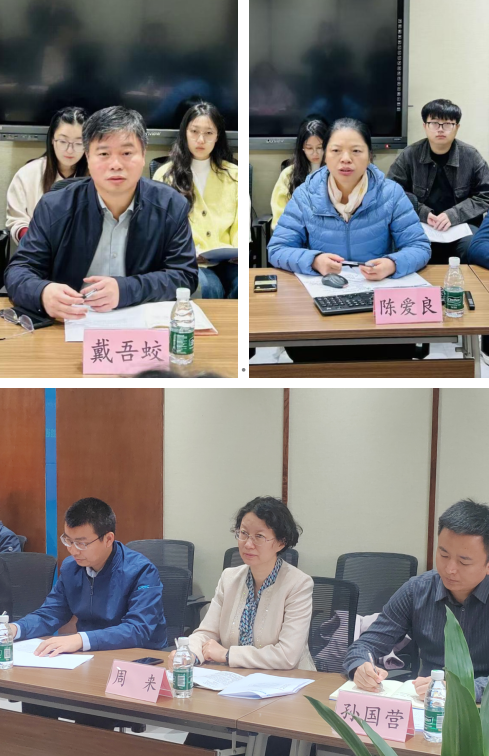
Focusing on Training Effectiveness: In-depth Discussion on Key Issues in Joint Training
During the discussion and exchange session, both parties conducted thorough and pragmatic discussions on the entire process of joint engineering master's and doctoral training.
First, the matching of enrollment quotas and needs: There has been a certain degree of "mismatch" between preliminary enrollment plans and training specialization directions. Enhanced pre-communication should be established, with a demand forecasting mechanism for enrollment driven by specific cooperative projects to achieve demand-oriented training.
Second, training process management and quality assurance: University and enterprise supervisors should connect as early as possible to jointly guide students in course selection, formulate training plans, and carry out research projects, ensuring seamless connection in training procedures.
Third, student mental health and humanistic care: Special attention should be paid to the psychological adaptation issues that joint training students may face when transitioning between university and enterprise environments. The linkage between university and enterprise counselors should be strengthened to jointly safeguard students' physical and mental health.
Fourth, vocational education continuity and student retention: It is necessary to deepen the emotional bond between the university and enterprise, formulate career development paths, and have enterprise experts deeply participate in school courses and lectures, thereby further enhancing the enterprise's attractiveness to students and students' sense of belonging.
Fifth, scientific research cooperation and platform co-construction:Both parties can jointly apply for national-level major scientific research projects, co-build joint laboratories and engineering technology centers, and jointly develop university-enterprise cooperative courses and engineering cases, expanding the carriers for university-enterprise joint training.
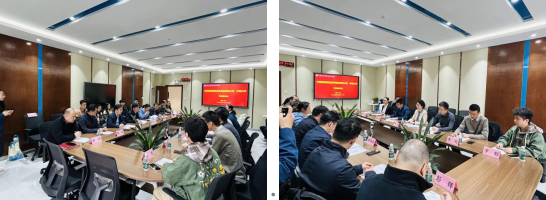
Looking Ahead to Future Cooperation: Working Together to Serve National Strategic Needs
In the meeting summary stage, both parties agreed that this exchange and discussion was highly effective. It not only identified current difficulties in university-enterprise joint training but also clarified directions for deepening cooperation in the future. Based on Central South University's profound accumulation in relevant disciplinary fields and China Railway Signal's leading position in the rail transit industry, both parties have broad prospects for cooperation.
Both parties agreed to establish a more normalized exchange mechanism to promote multi-level, high-frequency interactive exchanges between university and enterprise supervisors, management personnel, and students; strengthen collaboration in enrollment selection, curriculum development, project guidance, and process management; and strive to achieve more substantive cooperation results in national-level scientific research projects, platform co-construction, and the construction of overseas National Graduate College For Elite Engineers, jointly contributing to serving national strategies such as building a strong transportation nation and a strong talent nation.
The successful holding of this discussion marks a new phase in the cooperation between Central South University and China Railway Signal in joint master's and doctoral training, laying a solid foundation for subsequent deeper and broader collaborative innovation.
---
(First Review: Chen Chaoxia; Second Review: Lei Xiaoke; Final Review: Chen Ailiang)